

The best safety glasses are not the pair with the strongest marketing claim or the most fashionable frame. They are the glasses that match the workplace hazard, carry the required lens and frame markings, fit the wearer, and remain usable with helmets, respirators, and other personal protective equipment.
This is why a retail brand ranking is a poor starting point for industrial eye protection. A clear wraparound model for construction, a gray lens for outdoor work, and prescription safety glasses can all be appropriate, but they solve different problems. General-purpose safety glasses should also not be confused with sealed goggles, chemical-splash protection, or welding filters.
This guide explains how to compare impact protection, side coverage, anti-fog and anti-scratch coatings, lens tints, prescription options, and long-wear fit. It also covers the markings and documents that should be checked before a model is approved for workplace use.
Quick Answer: What Are the Best Safety Glasses for Work?
The best safety glasses for work provide the protection required by the hazard assessment and remain stable and clear during the task. For many construction and industrial jobs, this means suitable impact-rated glasses with side coverage, a clear field of view, a secure nose and temple fit, and an anti-fog option where heat, humidity, or respiratory PPE affects visibility.
| Workplace need | Safety-glasses direction | Main point to verify |
| Flying particles and general impact | Wraparound or side-protected impact-rated glasses | Lens and frame markings, coverage, and fit |
| Construction in changing temperatures | Impact-rated anti-fog safety glasses | Coating care, mask airflow, and workplace trial |
| Bright outdoor work | Suitable gray, smoke, or other approved tint | Light transmission, color recognition, and task visibility |
| Indoor or low-light work | Clear lens or suitable task-specific lens | Optical clarity and lighting conditions |
| Prescription wearer | Prescription safety glasses or an approved eyewear system | Prescription marking, side protection, and optical alignment |
| Liquid splash or fine dust | Evaluate a suitable safety goggle instead | Enclosure and exact hazard-use marking |
| Welding or harmful optical radiation | Task-specific filtered eye and face protection | Correct shade and applicable standard |
No single pair should be assumed to cover every row. Identify the hazard first, then verify the exact model and configuration.
Safety Glasses vs Safety Goggles vs Face Shields
Safety glasses resemble ordinary spectacles but are designed and tested for occupational protection. Suitable models can protect against impact and flying particles, and side shields or a wraparound lens can reduce exposure from the sides. However, the open space around the frame limits the enclosure.
Safety goggles surround the eye area more closely. A suitable goggle may be required where liquid splash, fine dust, or another hazard needs greater enclosure. Its vent type, seal, and hazard marking must still match the task.
A face shield covers more of the face, but it is not automatically a replacement for primary eye protection. For many impact or splash tasks, a shield is worn over suitable safety glasses or goggles. The complete combination should follow the workplace risk assessment and applicable requirements.
| Protection format | Main strength | Important limitation |
| Safety glasses | Lightweight impact protection and side coverage when correctly rated | Open gaps provide less enclosure for splash and fine dust |
| Safety goggles | Greater enclosure for selected dust or splash hazards | More heat and fogging potential; exact design and marking matter |
| Face shield | Additional coverage for the face | Often supplementary rather than primary eye protection |
Ordinary fashion glasses, sports glasses, and prescription spectacles are not occupational eye protection unless the exact product carries the required safety markings.
Start with the Workplace Eye Hazard
Eye-protection selection should begin with the task, not a catalog feature. OSHA identifies eye and face hazards that include flying particles, molten metal, liquid chemicals, acids or caustic liquids, chemical gases or vapors, and potentially harmful light radiation. Different protective systems may be needed for these exposures.
For safety glasses, the most common starting point is impact from flying particles. Grinding, drilling, cutting, machining, woodworking, and many construction activities can release fragments toward the eyes. The glasses need the applicable impact rating and side coverage, but the employer must still determine whether open eyewear provides enough protection.
If liquid can splash around the frame, fine dust can enter through gaps, or the task creates harmful optical radiation, general-purpose clear safety glasses may be insufficient. A suitable goggle, face shield, filtered protector, or combination may be required.
Multiple hazards can occur together. A worker grinding a coated metal part may face impact, dust, and chemical-residue concerns. A model chosen only because it is lightweight or anti-fog does not resolve the full assessment.
Impact Protection and Side Coverage
Impact-rated safety glasses are designed as a complete lens-and-frame system. A strong lens material alone does not prove that the product will retain the lens or maintain coverage during impact. The lens, frame, side protection, and markings must be evaluated together.
Polycarbonate is common in industrial safety eyewear because it can provide useful impact performance at a low weight. Other materials and constructions are also available. Material names such as polycarbonate or TR-90 should be treated as product information, not as proof of a safety rating.
Side protection matters when flying objects can approach from an angle. It may be provided by an integrated wraparound lens, a fixed side shield or an appropriate detachable shield. The design should not create large gaps when the wearer turns, looks down, or combines the glasses with other PPE.
Avoid absolute descriptions such as shatterproof or protection from any hazard. Standards use defined test conditions, and no safety glass provides unlimited protection.
Understanding ANSI Z87.1 Markings
ANSI/ISEA Z87.1 is a widely used U.S. consensus standard for occupational and educational eye and face protection. Under the marking system, Z87 is associated with a basic-impact classification and Z87+ with high-impact protection. Prescription safety eyewear may use markings such as Z87-2 or Z87-2+ according to the product and standard edition.
Buyers should review:
– The marking on the lens.
– The marking on the frame or temple.
– The manufacturer’s identification.
– The standard edition and product instructions.
– Any additional marking for optical radiation or another claimed function.
– The exact relationship between the product, certificate, and test report.
The plus sign is part of the high-impact marking; it is not the name of an ANSI Z87.1+ standard. Also avoid phrases such as ANSI-approved or OSHA-approved. A product marking does not remove the employer’s responsibility to assess the hazard and select appropriate protection.
Different lens colors, coatings, or frame configurations in one product family may have different markings. Do not transfer a test report from one version to every model that looks similar.
EU Eye-Protection Standards and Documents
For products placed on the EU market, the exact model should have the applicable conformity assessment, CE marking, and supporting documents. The current EU harmonized standards list includes EN ISO 16321-1:2022, Eye and face protection for occupational use – Part 1: General requirements. Additional parts address uses such as welding and mesh protectors.
Older product files and catalogs may still refer to EN 166. Buyers should not assume that an old standard reference, certificate, or product-family statement automatically establishes current conformity for a new order. Check the model identifier, product marking, EU Declaration of Conformity, certificate scope, and any applicable transition information.
CE marking is not a claim that one pair suits every hazard. The declared protection, lens, frame, and supplied configuration must agree with the documents.
How to Choose Anti-Fog Safety Glasses for Construction
Fogging occurs when warm, humid air reaches a cooler lens, and moisture condenses. Construction work can intensify this process because workers move between indoor and outdoor temperatures, perform physically demanding tasks, and wear masks or respirators that may direct exhaled air upward.
An anti-fog coating can reduce the formation of vision-obscuring droplets, but its performance depends on the coating, lens condition, and work environment. Some products use a factory-applied treatment on one or both sides of the lens. Buyers should review the test basis and care instructions for the exact model rather than relying on a general fog-proof claim.
Frame position also affects airflow. Glasses that sit very close to the face may reduce some particle entry but trap more warm air. Glasses that sit farther away may ventilate better but create larger gaps. The best balance depends on the hazard, face shape, and other PPE.
A mask or half-mask respirator should not push the glasses out of position. Its nose area and exhalation path should also be checked because upward leakage can fog the lens. Trial the complete combination with the actual safety helmet, hearing protection, and respiratory PPE used on site.
Representative testing is more useful than a catalog promise. Ask workers to wear samples during normal movement, temperature changes, and physical effort. Check clarity, slip, pressure, gaps, and whether the glasses are repeatedly removed for wiping.
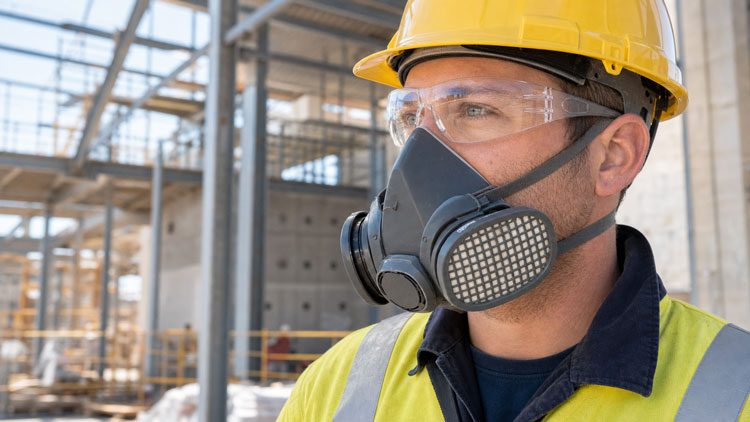
Image caption: Anti-fog safety glasses should be trialed with the worker’s actual helmet, mask, or respirator because face fit and upward exhaled airflow affect lens clarity.
No safety glass is guaranteed to remain fog-free in every temperature, humidity, and PPE combination. The objective is reliable visibility under the assessed working conditions, supported by correct care and replacement.
Anti-Fog and Anti-Scratch Coatings
Anti-fog and anti-scratch are different functions. A lens may have one coating, both coatings, or a treatment with different properties on each surface. The product data should identify what is supplied.
Anti-scratch does not mean scratch-proof. Dry wiping a dusty lens can drag particles across the surface. Abrasive cloths, strong solvents, and unapproved cleaning chemicals may damage the coating or cause clouding. Remove loose particles first and follow the manufacturer’s instructions.
Coating performance changes with wear. Replace the glasses if scratches, haze, or coating damage obstruct vision or create optical distortion. A low-cost pair that requires frequent replacement may not be the most economical crew option when visibility, worker acceptance, and issue frequency are considered together.
For sample evaluation, use a simple documented process: inspect the lens before the issue, record the cleaning method, observe fogging and clarity during representative work, and inspect the coating again after the trial. This does not replace a laboratory test, but it helps determine whether the selected product is practical for the workforce.
Clear, Gray, Amber, and Special-Purpose Lenses
Lens color should match the lighting and task. Appearance alone does not prove UV, glare, impact, or welding performance.
| Lens direction | Typical selection context | Main limitation to consider |
| Clear | General indoor work, inspection, and areas where maximum visible light is needed | Does not reduce bright outdoor glare and is not a welding filter |
| Gray or smoke | Selected outdoor work in bright daylight | Can reduce visibility indoors, in shade, or during changing light |
| Amber or contrast lens | Selected low-contrast or variable-light conditions | Can alter color perception; verify task suitability |
| Indoor/outdoor lens | Work moving between different brightness levels | Performance and light transmission vary by model |
| Task-specific filter | Welding, laser, or other optical-radiation work | Requires the correct shade, marking, and protective system |
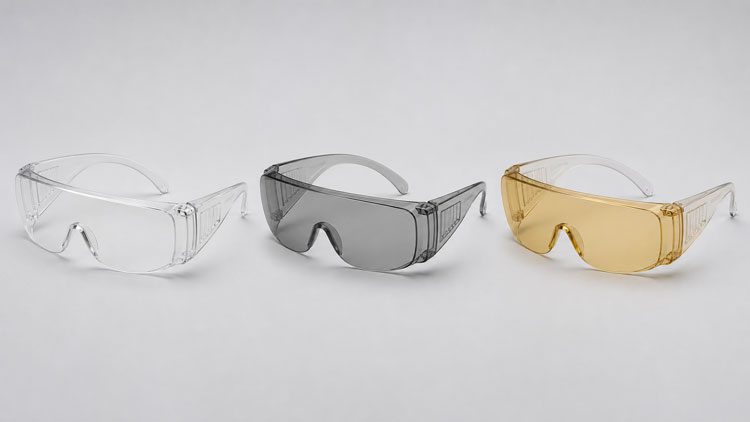
Image caption: Clear, gray, and amber lenses serve different lighting needs. Lens color should be selected with the task, light transmission, color recognition, and product markings in mind.
Clear lenses are a common choice for general construction, manufacturing, and warehouse work, but outdoor crews may need glare control. Gray or smoke lenses can be useful in bright daylight if the tint and optical properties are appropriate for the job. They should not be worn automatically in dark interiors or at dusk.
Amber lenses may be selected to change contrast in some conditions, but they also change color perception. That can matter when workers read color-coded signs, wires, labels, or process indicators. A trial should check whether the lens helps the task without hiding important visual information.
Ordinary dark safety glasses are not welding glasses. Welding, cutting, laser work, and other harmful optical-radiation tasks require task-specific filters and, where necessary, additional face protection.
Fit, Comfort, and Long-Wear Stability
A safety rating does not guarantee that one frame fits every face. Nose shape, head width, brow profile, and cheek position affect coverage and stability. The product should remain in its intended position while the wearer looks up, looks down, bends, and moves.
During a fit trial, check:
– Gaps around the brow, sides, and cheeks.
– Side coverage and peripheral vision.
– Nose-bridge grip without painful pressure.
– Temple length, flex, and pressure behind the ears.
– Slip during sweating or movement.
– Contact with helmet suspension or earmuffs.
– Interference with a mask, respirator, or face shield.
– Fogging during work rather than only while standing still.
Comfort supports consistent use, but it cannot replace protection. A very loose frame may feel comfortable while leaving large gaps. Excessive temple pressure may cause workers to remove the glasses. Providing more than one suitable fit option can be more practical than calling one design universal.
Style can also influence worker acceptance. A modern appearance is useful when it encourages correct wear, but it should be considered only after the required markings, coverage, and fit have been confirmed.
Prescription Safety Glasses
Ordinary prescription spectacles are not automatically safety glasses. They may break, lose a lens, or lack the required side protection during an industrial impact.
Prescription safety eyewear should carry the applicable lens and frame markings, maintain the wearer’s optical correction, and provide the protection required by the task. Side coverage, frame fit, and lens retention remain important.
Other options include an approved prescription insert or a suitable over-the-glasses goggle. OTG goggles may be more appropriate where greater enclosure is required, but they must not disturb the position of either lens system.
Tight-fitting full-face respirators often require a dedicated spectacle insert so that temple arms do not pass through the respirator seal. Follow the respirator manufacturer’s instructions and the workplace respiratory-protection program.
Safety-Glasses Selection by Workplace
| Workplace or task | Main selection focus |
| Construction | High-impact marking, anti-fog performance, side coverage, and helmet or respirator fit |
| Manufacturing | Impact, optical clarity, long-wear comfort, and task lighting |
| Woodworking | Flying particles, side coverage, and the boundary between glasses and dust goggles |
| Mining and quarrying | Impact, dust exposure, and respirator compatibility; a greater enclosure may be needed |
| Outdoor utility work | Impact, suitable tint, UV or filter marking, and changing light |
| Warehouse and visitors | Clear vision, simple adjustment, hygiene, and task-specific impact protection |
| Laboratory and chemical work | Assess splash exposure; suitable goggles and a face shield may be required |
These are selection priorities, not fixed product prescriptions. Two tasks in the same facility may need different eye protection because the hazards and lighting differ.
How to Choose Industrial Safety Glasses Step by Step
1. Identify the Hazard
Record the source, direction, and severity of impact, particles, dust, splash, or optical radiation. Determine whether open safety glasses provide enough coverage.
2. Define the Required Marking
Identify the applicable impact and optical requirements for the workplace and destination market. Verify both lens and frame markings.
3. Select the Lens for the Lighting
Choose a clear, gray, amber, or another suitable lens based on the task, light transmission, color recognition, and any required filter marking.
4. Decide Whether Coatings Are Needed
Consider temperature changes, humidity, masks, respirators, dust, and the cleaning process. Compare anti-fog and anti-scratch options without treating either as permanent.
5. Trial the Fit
Use representative workers and the actual helmet, hearing protection, respirator, and face shield. Check movement, pressure, gaps, peripheral vision, and fogging.
6. Confirm Care and Replacement
Review cleaning instructions, storage, coating care, inspection criteria, and replacement supplies. Include shared visitor eyewear in the hygiene process.
7. Match the Documents to the Product
The model number, photographs, markings, packaging, instructions, certificate, and test report should agree with the final configuration.
Cleaning, Inspection, and Replacement
Inspect safety glasses before issue and use. Look for scratches, cracks, haze, discoloration, loose lenses, distorted frames, damaged temples, and unreadable markings. A frame that no longer sits correctly may not provide the intended coverage.
Remove loose dust before wiping the lens. Use only the cleaner, cloth, and disinfection method allowed by the manufacturer. Store eyewear where the lens is protected from abrasive tools, direct heat, and chemical contamination.
Replace the glasses when vision cannot be restored, the frame is damaged, the fit has changed, or the product can no longer be identified. Occupational safety glasses should not routinely be sourced as unverified used PPE because their impact history, coating condition, hygiene, and document traceability may be unknown.
Common Safety-Glasses Selection Mistakes
– Choosing by brand, appearance, or price before assessing the hazard.
– Assuming every product marked ANSI suits impact, splash, dust, and welding.
– Treating anti-fog or anti-scratch as permanent performance.
– Wearing dark safety glasses indoors without checking task visibility.
– Treating tinted lenses as welding filters.
– Assuming ordinary prescription or sports glasses are occupational PPE.
– Ignoring gaps, slips, and interference with other PPE.
– Accepting a certificate that does not match the exact model and configuration.
ANBU Safety-Glasses Options for Industrial Buyers
ANBU Safety’s current range includes clear anti-fog glasses, anti-scratch glasses, construction styles, dark-lens options, and models described for ANSI- or EU-related markets. These categories can support construction, factory, mining, visitor, and mixed PPE purchasing, but the final model should be selected by hazard and documentation rather than the category name alone.
Before bulk approval, confirm the lens and frame markings, coating, tint, target-market standard, certificate or test report, product instructions, and packaging for the exact version. Samples should be evaluated for fit, optical clarity, fogging, and compatibility with other PPE on representative users.
For an initial inquiry, provide the intended task, main hazard, destination market, estimated quantity, and required marking or document. Logo, color, label, and packaging details can be finalized after the protective configuration is confirmed.
Frequently Asked Questions
What safety glasses are best for construction work?
Suitable construction safety glasses should match the assessed impact and flying-particle hazards, provide the required side coverage, and fit securely with the worker’s helmet, mask, or respirator. For many industrial applications, buyers look for the applicable high-impact marking, clear optical quality, and anti-fog performance. Dust, splash, or welding tasks may require a different form of eye or face protection.
What is the difference between Z87 and Z87+ safety glasses?
Under the ANSI/ISEA Z87.1 system, Z87 identifies a basic-impact classification, and Z87+ identifies high-impact protection. Marking requirements vary by product type and standard edition, so check both the lens and frame, the manufacturer’s identification, and the instructions for the exact model.
How can workers reduce fogging in safety glasses?
Use safety glasses with a suitable anti-fog coating, keep the lenses clean according to the manufacturer’s instructions, and check whether a mask or respirator directs exhaled air toward the lenses. Fit, temperature, humidity, and physical effort all affect fogging, so evaluate samples under representative working conditions rather than relying on a fog-proof claim.
Are tinted safety glasses suitable for indoor or welding work?
Tinted lenses can reduce visible light and may be suitable for selected outdoor or bright-light work when correctly marked. They can reduce visibility indoors or in low light. Ordinary dark lenses are not welding filters; welding and other harmful optical-radiation tasks require the correct task-specific shade and protective system.
What documents should bulk buyers verify before ordering safety glasses?
Verify the exact model, lens and frame markings, applicable standard, certificate or test report, product instructions and target-market documents. The photographs, packaging, and supplied configuration should match the documents. Buyers should also use samples to evaluate fit, optical clarity, coating performance, and compatibility with other PPE.
Conclusion
The best safety glasses are the glasses that match the assessed hazard, carry the required markings, and fit the wearer without interfering with other PPE. Compare impact rating, side coverage, lens tint, coating care, and prescription needs before choosing by price or appearance.
For construction and industrial work, anti-fog performance should be judged under realistic temperature, activity, and PPE conditions. Where liquid splash, fine dust, or harmful optical radiation is present, select the appropriate goggle, face protection, or filtered system rather than assuming general-purpose clear glasses are sufficient.


 English
  Spanish
  French